Quick answer
- Quick answer
- Separate routing from failover
- Use one logical payment ledger
- Define the payment state machine
- Choose trustworthy health signals
- Understand provider-scoped idempotency
- Preserve tokens, authentication, and method behavior
- Handle webhooks, refunds, disputes, and settlement
- Choose fail-open, fail-closed, or manual fallback
- Test the routing architecture
- Decide whether orchestration is worth it
- FAQ
- Sources
Safe WooCommerce payment gateway failover is not:
Provider A timed out, so immediately charge Provider B.
A timeout can mean Provider A never received the request—or it can mean Provider A authorized or captured while the response was lost.
Use these rules:
- Route by country, currency, cart, payment method, account, and contract before creating a payment attempt.
- Create one logical payment record for the WooCommerce order.
- Give each provider attempt its own ID, state, idempotency key, and provider reference.
- Allow at most one active financial attempt for the logical payment.
- If the request outcome is unknown, retrieve and reconcile the original provider object.
- Route to another provider only after proving the first attempt had no financial effect and is terminal.
- Do not treat issuer declines, fraud blocks, or customer authentication failures as provider outages.
- Keep tokens, wallets, 3-D Secure, refunds, disputes, webhooks, and settlement bound to the original provider.
- Use a circuit breaker with reliable health evidence and controlled recovery probes.
- Fail closed when duplicate-charge risk is greater than the cost of temporary unavailability.
Sometimes the safest “failover” is displaying another payment method before the shopper submits. Sometimes it is asking the shopper to return later. Automated processor retry is the highest-risk option.
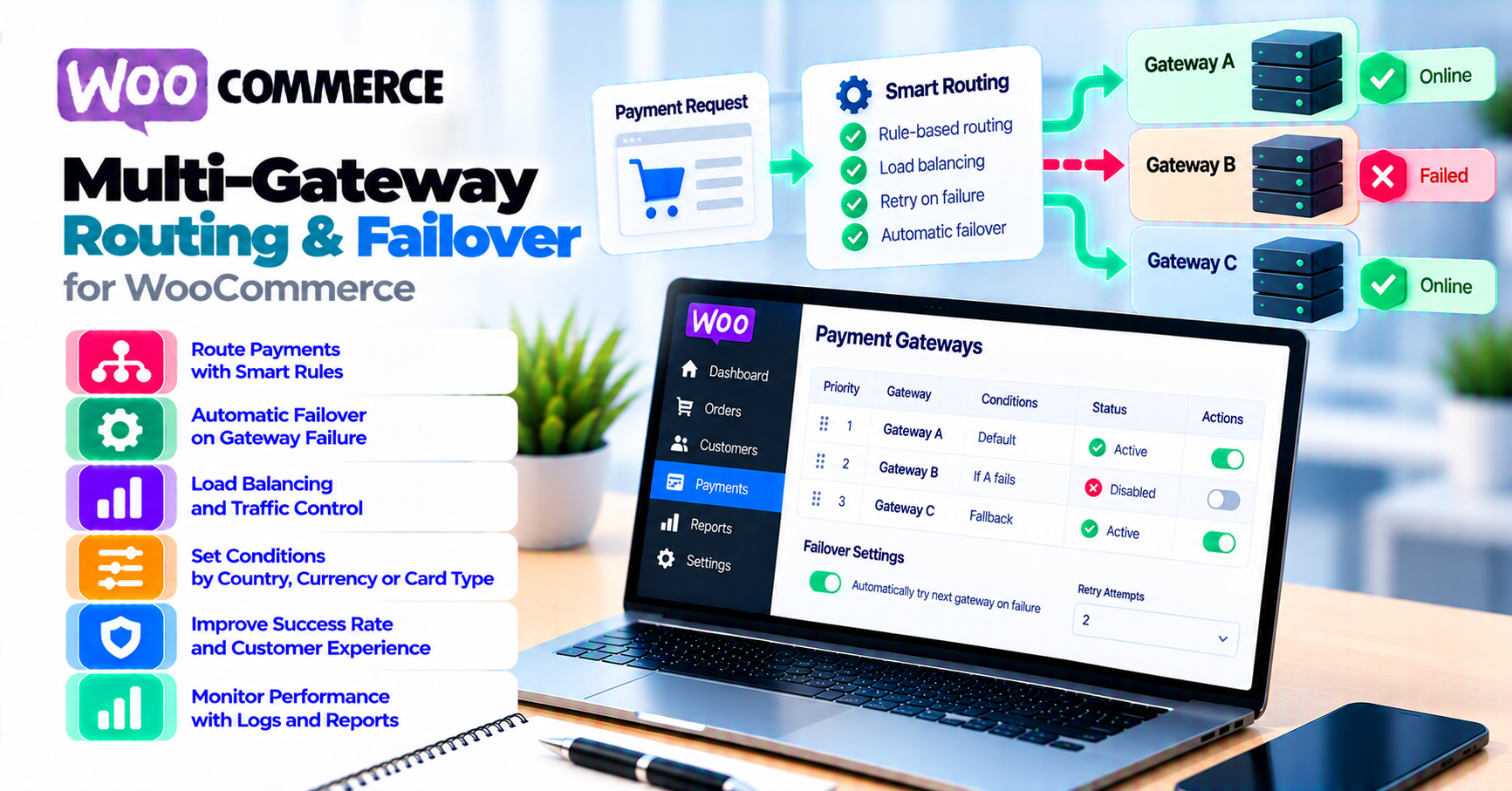
Separate routing from failover
Use precise terms.
Static eligibility routing
Choose a provider before payment based on known order context:
- Merchant entity
- Billing or shipping country
- Charge currency
- Amount
- Product or subscription requirements
- Payment method
- Provider contract
- Token ownership
This is normal availability. PatSaTECH’s completed availability-policy bundle covers the rule matrix.
Preference routing
Choose among eligible providers using:
- Cost
- Approval performance
- Local acquiring
- Settlement currency
- Operational preference
Preference must never override hard capability or legal/contractual constraints.
Health routing
Stop sending new attempts to a provider when credible evidence says it is degraded.
This is where a circuit breaker can help.
Attempt failover
After one provider has received—or may have received—a payment request, decide whether another provider may be attempted.
This is dangerous because:
- The first result may be unknown.
- Provider idempotency does not span processors.
- A second gateway can authorize the same order.
- Authentication and tokens may not be portable.
- Webhooks can arrive out of order.
Treat attempt failover as a financial state transition, not a load-balancer retry.
Use one logical payment ledger
WooCommerce has an order, but multi-gateway routing needs an explicit cross-provider attempt record.
Logical payment
One customer obligation:
- WooCommerce order ID
- Amount and currency
- Customer and merchant entity
- Cart/payment requirements
- Current routing state
- Final financial outcome
- Fulfillment gate
Provider attempt
One interaction with one provider:
- Internal attempt ID
- Logical payment ID
- Provider and merchant account
- Operation
- Provider idempotency key
- Request time
- Request/correlation ID
- Provider payment or transaction ID
- State
- Authentication context
- Error or decline evidence
- Webhook event IDs
- Last retrieval time
Core invariants
- One logical payment can have multiple historical attempts.
- Only one attempt can be financially active at a time.
- Success at any provider closes new-attempt routing.
- Unknown is not failure.
- A terminal decline does not automatically prove another provider may retry the same method.
- Every refund, void, capture, dispute, and reconciliation action targets the provider that owns the transaction.
- Fulfillment happens once.
Persist before sending
Create and save the attempt record before the provider request. If the process crashes, operations still know which provider was targeted and which idempotency key and order were involved.
Do not store full card data in the ledger.
Define the payment state machine
Use explicit transitions.
| State | Meaning | Can route elsewhere? |
|---|---|---|
created |
No provider chosen | Yes |
eligible |
Candidate providers passed hard rules | Yes |
routed |
Provider selected, request not sent | Yes, with audit |
submitted |
Request sent | No |
requires_action |
Customer authentication required | No; resume original |
authorized |
Funds authorized, uncaptured | No |
processing |
Provider result pending | No |
succeeded |
Payment completed | No |
terminal_failed_no_effect |
Provider confirms no auth/capture and policy permits | Possibly |
unknown |
Request outcome cannot yet be proven | No |
canceled_or_voided |
Original financial effect safely closed | Possibly |
manual_review |
Human decision required | No automatic route |
Before submission
Routing can change safely while no provider request has been sent.
Examples:
- Provider A is already circuit-open.
- Currency is unsupported.
- Token belongs to Provider B.
- Wallet is available only through Provider B.
After an explicit terminal failure
Another route might be allowed when:
- Provider confirms no authorization or capture.
- Failure is not a fraud or compliance instruction that should stop attempts.
- Contract and card-scheme rules permit another attempt.
- Customer messaging is clear.
- Retry count and velocity controls permit it.
Do not route every do_not_honor or risk decline to another acquirer. That can look like decline laundering and increase fraud risk.
After timeout or 5xx
Move to unknown.
Then:
- Retry the same provider request only through documented idempotency when appropriate.
- Retrieve the provider payment state.
- Check webhooks and request logs.
- Wait for processing state where required.
- Escalate if the result remains indeterminate.
Do not route to Provider B merely because Provider A’s HTTP response was absent.
After authentication begins
Resume or close the original authentication flow. A new provider can create a second payment and a confusing shopper experience.
Choose trustworthy health signals
Health routing needs evidence stronger than one failed order.
Useful signals
- Provider status page or incident API
- Transport error rate
- Provider
5xx - Timeout rate
- Rate-limit responses
- Latency versus baseline
- Authentication-return failures
- Webhook delivery failure
- Region, method, or API-specific degradation
- Your own success rate after excluding issuer and risk declines
Signals that do not prove provider outage
- Insufficient funds
do_not_honor- Fraud block
- AVS or CVV mismatch
- Customer abandoning 3-D Secure
- Unsupported currency
- Expired API key
- Broken plugin deploy
- One office or ISP problem
Normalize response codes before feeding them into health.
Circuit breaker
A circuit breaker can use:
- Closed: new attempts allowed.
- Open: new attempts not sent.
- Half-open: controlled probes test recovery.
Record:
- Signal source
- Threshold and window
- Minimum sample size
- Open duration
- Probe policy
- Owner
- Manual override
- Audit trail
Do not test recovery by firing uncontrolled live charges. Use health endpoints, safe provider calls, sandbox where meaningful, or a tightly approved low-value production check.
Avoid flapping
Use hysteresis:
- Stronger evidence to open
- Sustained recovery to close
- Minimum dwell time
- Limited half-open probes
Rapidly switching providers can be worse than a short outage.
Understand provider-scoped idempotency
Stripe’s idempotent-request documentation says the same provider can safely recognize a retried create or update request when the same idempotency key and parameters are used.
Adyen’s idempotency documentation and PayPal’s idempotency documentation define their own headers, retention, and API support.
Important:
- A Stripe idempotency key has no meaning to Adyen.
- An Adyen idempotency key does not deduplicate a PayPal request.
- Reusing the same text across providers does not create global idempotency.
Your application needs a logical-payment lock and provider-attempt ledger.
Retry in one layer
AWS guidance on timeouts, retries, backoff, and jitter warns that retries can amplify load and side effects and should be controlled at an appropriate layer.
Do not let:
- HTTP client
- gateway SDK
- WooCommerce plugin
- orchestration service
- queue worker
- customer browser
all retry independently.
Backoff is not reconciliation
Backoff reduces retry pressure. It does not answer whether the first payment succeeded.
Retrieve provider state before a cross-provider route.
Preserve tokens, authentication, and method behavior
Tokens are provider-bound
A saved payment token usually belongs to one provider vault and merchant account.
Failover can require:
- Customer re-entry
- New tokenization
- New consent
- Different mandate
- Different stored-credential flags
Do not copy provider tokens across processors.
Wallets
Wallet availability can depend on:
- Domain verification
- Provider account
- Device and browser
- Country and currency
- Merchant ID
Failover can remove the wallet option entirely. Provide a compatible fallback, not a hidden processor switch that breaks the wallet token.
3-D Secure
Stripe’s PaymentIntent lifecycle is one provider example of states including requires action, processing, requires capture, succeeded, and canceled.
Once authentication is attached to Provider A’s object, Provider B cannot simply continue that object.
Subscriptions
Renewal tokens and billing agreements remain with the original provider. Multi-gateway checkout routing does not automatically fail over future renewals.
Alternative methods
Bank debits, BNPL, local methods, and redirects can remain pending for hours or days. “Slow” is not necessarily “down.”
Use international payments and currency guidance when regional and method eligibility drives routing.
Handle webhooks, refunds, disputes, and settlement
Webhooks from every provider
Each provider can send:
- Success
- Failure
- Capture
- Refund
- Dispute
- Pending or delayed state
Map every event to:
- Logical payment
- Provider attempt
- WooCommerce order
- Current state
Events can arrive after another route is considered. If Provider A reports success, lock the logical payment even if Provider B was about to start.
Use webhook monitoring for delivery and order correlation.
Out-of-order and duplicate events
Store provider event IDs. Make duplicate processing a no-op. Apply valid state transitions rather than “last webhook wins.”
Refunds and voids
Refund at the provider that owns the charge.
Do not:
- Refund Provider B for a Provider A capture.
- Mark WooCommerce refunded without confirming provider result.
- Assume identical partial-refund behavior.
Disputes
Evidence and deadlines are provider-specific. Preserve:
- Provider
- Transaction ID
- Order ID
- Fulfillment
- Customer communication
Settlement and finance
Multiple providers create:
- Separate fees
- Payout schedules
- Reserves
- FX
- Statements
- Refund timing
- Dispute balances
Finance must reconcile by provider attempt, not only WooCommerce order.
Choose fail-open, fail-closed, or manual fallback
Fail open to another provider
Use only when:
- First provider has not received the request, or a terminal no-effect state is proven.
- Alternate provider supports the exact method and order.
- Global attempt lock is working.
- Customer experience is coherent.
- Fraud and contractual rules permit it.
Fail closed
Prefer when:
- Outcome is unknown.
- Provider object is processing.
- Authentication began.
- Duplicate charge risk is material.
- Routing evidence is weak.
- Order is high value.
- Tokens or mandates are provider-bound.
Show:
We are confirming your payment result. Please do not submit again.
Manual fallback
Operations review:
- Provider state
- Gateway dashboard
- Webhooks
- Order notes
- Attempt ledger
Then choose:
- Resume Provider A
- Void/cancel A and route B
- Offer another method
- Contact customer
- Wait
Shopper-selected alternate method
Often safer than invisible automated failover:
- Bank transfer
- Wallet
- Card via another gateway
- Invoice
The shopper understands a new payment attempt is being made.
Test the routing architecture
Use sandbox/provider test tools and synthetic WooCommerce orders.
Pre-attempt routing
- Country and currency eligibility
- Amount boundary
- Method availability
- Provider circuit open
- Static preference
- Token-bound provider
Attempt states
- Provider A success
- Explicit terminal decline
- Fraud/risk block
- Authentication required
- Authorization only
- Processing
- Timeout before send
- Timeout after send
- Provider
5xx - Rate limit
Cross-provider safety
- Unknown A never routes B
- Success A locks payment
- Late success A stops B before submission
- Terminal no-effect A can route B only once
- Duplicate browser submit is blocked
- Idempotent retry stays within A
- Webhook duplicate is a no-op
- Refund targets owning provider
Circuit breaker
- Opens on approved health evidence
- Ignores issuer declines
- Does not flap
- Half-open uses controlled probes
- Manual override is audited
- Recovery returns new attempts gradually
Finance
- Provider transaction maps to attempt
- Fees and payout reconcile
- Refund and dispute stay with provider
- Order closes once
Failure injection
Simulate:
- Network drop
- Delayed response
- Delayed webhook
- Process crash after request
- Database write failure
- Queue retry
- Multiple web nodes
Verify the persisted ledger recovers safely.
Decide whether orchestration is worth it
Multi-gateway routing adds:
- Engineering and testing
- Provider contracts
- Reconciliation
- Fraud/risk alignment
- Token and method fragmentation
- Support training
- Monitoring
- Incident ownership
- Compliance review
It can help when:
- Multiple merchant entities require routing.
- Local acquiring materially improves approval or cost.
- One provider lacks a needed method.
- Resilience justifies the complexity.
- The store has volume, staffing, and finance maturity.
It can hurt when:
- Checkout volume is modest.
- Provider outcomes cannot be retrieved reliably.
- Tokens and subscriptions dominate.
- Finance cannot reconcile two processors.
- The implementation is “retry elsewhere on error.”
- Support cannot explain the state.
Start with payment-gateway outage resilience and plugin evaluation. An alternate payment method and clear communication can provide resilience without automated cross-processor failover.
FAQ
Can WooCommerce automatically retry another gateway after a timeout?
It can be custom-built, but it is unsafe until the original provider outcome is reconciled. Timeout means unknown, not failed.
Does using the same idempotency key across providers prevent duplicates?
No. Idempotency keys are interpreted by each provider. The application needs a cross-provider logical-payment lock and attempt ledger.
Should all declines fail over?
No. Issuer declines, fraud blocks, authentication failures, and unsupported transactions are not proof of provider outage. Retrying them elsewhere can increase fraud and compliance risk.
What signals should open the circuit breaker?
Use provider and internal transport errors, 5xx, timeout, rate-limit, latency, and webhook evidence with adequate sample sizes. Exclude customer/issuer and fraud decisions.
Can saved cards fail over?
Usually not directly. Tokens are generally bound to a provider vault and merchant account. The customer may need to re-enter a payment method under a supported flow.
How do refunds work after failover?
Refund through the provider that owns the successful charge, then reconcile WooCommerce and finance records.
Is showing two gateways the same as failover?
No. Shopper choice presents alternatives before payment. Automated failover makes a routing decision after or around an attempt and requires much stronger state control.
What if Provider A succeeds after Provider B starts?
The design failed its one-active-attempt invariant. Stop fulfillment, reconcile both providers, void or refund according to state and policy, notify support, and fix the race.
Sources
Primary sources accessed September 20, 2026:
- WooCommerce developer docs — Payment Gateway API
- Stripe API Reference — Idempotent requests
- Stripe Docs — PaymentIntent lifecycle
- Adyen Docs — API idempotency
- PayPal Developer — Idempotency
- AWS Builders’ Library — Timeouts, retries, and backoff with jitter
This article provides general architecture guidance, not permission to retry payments across processors. Confirm provider contracts, card-scheme rules, compliance, idempotency, payment states, and customer communication before implementing routing.