Introduction
- Introduction
- Quick answer
- 1. What tokenization is (in plain English)
- 2. PCI scope and who stores what
- 3. WooCommerce patterns: guests, logged-in, subscriptions
- 4. Network tokens and card updates
- 5. Deletion and consent
- 6. Security practices for tokenized data
- 7. Testing checklist
- FAQ
- Related reading
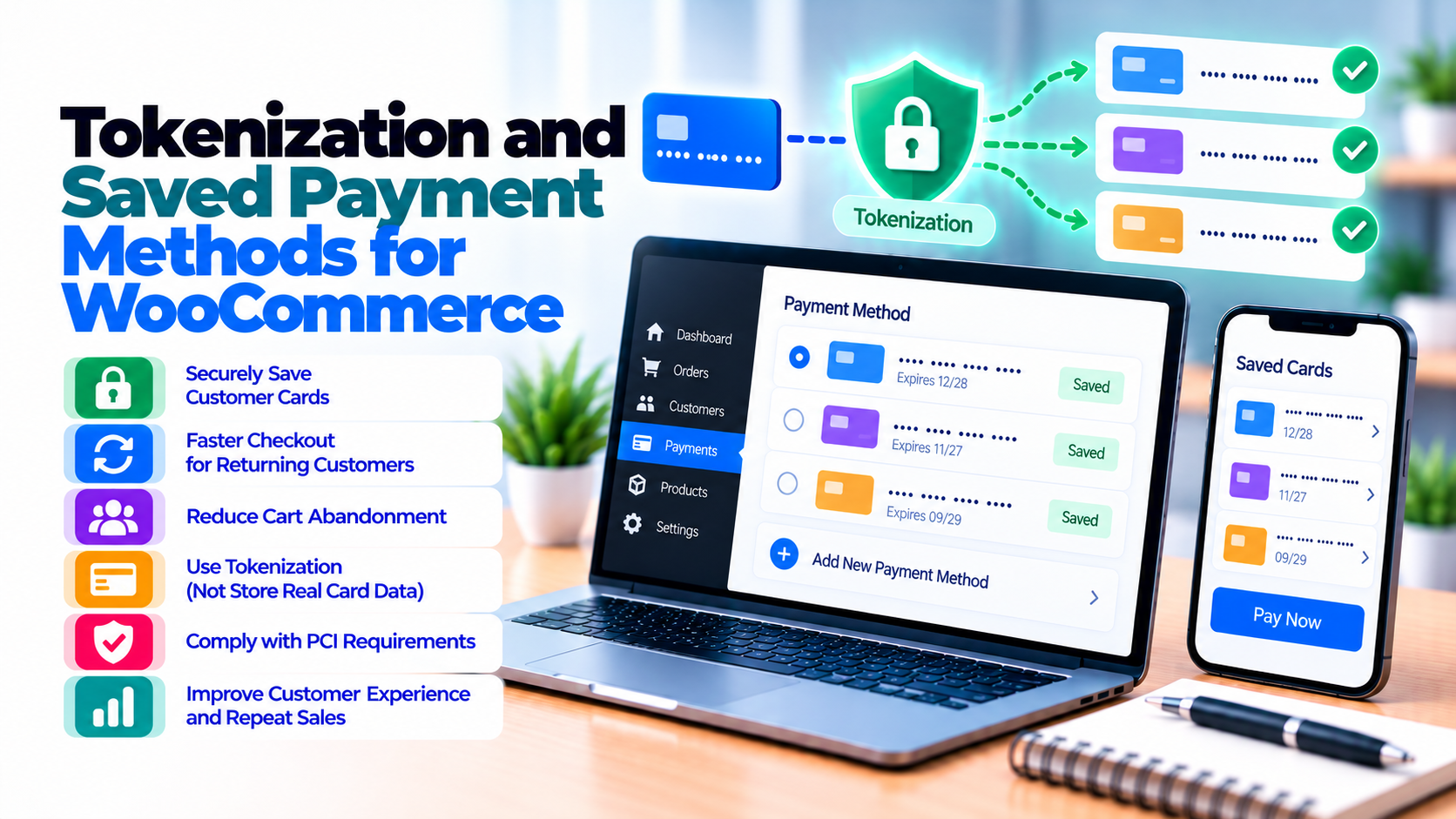
Customers expect “save my card” to mean one-click checkout next time. Behind that button is tokenization: the full card number is replaced by a reference your gateway can charge again without your server storing the primary account number. WooCommerce does not magically vault cards by itself—the payment gateway plugin, processor vault, and sometimes the card networks cooperate to make renewals and one-click possible.
This article connects PCI scope for merchants, subscriptions and payment gateways, authorization and capture, and how to evaluate payment gateway plugins. It is written for merchants and agencies who need to explain saved cards to support and finance without overpromising portability.
Quick answer
Tokenization lets you charge again with a gateway reference, not a card number on your disk. PCI obligations drop when you never handle raw card data—but you still must secure your site, restrict admin access, and use plugins that integrate with your processor’s vault correctly. Test subscription renewals, one-click checkout, and “remove card” flows in sandbox before marketing “saved cards everywhere.”
1. What tokenization is (in plain English)
When a customer enters a card, the gateway often returns a token (or payment method ID) that stands in for that card for future charges. Your WooCommerce database may store that token in order meta or customer meta, depending on the plugin. The next charge uses the token; the customer may need to re-authenticate for SCA in some regions—see 3-D Secure and SCA.
Tokens are not interchangeable between processors. Migrating gateways often means asking customers to re-enter cards unless your old and new providers support a formal portability program—migrating payment gateway.
2. PCI scope and who stores what
If card data never touches your server (hosted fields, redirect, or JS that tokenizes client-side), your scope is narrower than if you post PAN to your own API. “We only store tokens” still requires you to protect admin accounts, backups, and logs that might leak tokens or personal data.
Saved payment methods increase the blast radius of a compromised admin account—enforce MFA, role separation, and audit trails. Align with your PCI scope article and official PCI SSC guidance for your setup.
3. WooCommerce patterns: guests, logged-in, subscriptions
- Guest checkout: Some gateways allow “remember me” via token tied to email plus verification—policy and UX vary.
- Logged-in customers: “Saved cards” in account area requires plugin support and clear consent copy.
- Subscriptions: Renewal charges rely on tokens; failed renewals trigger dunning—coordinate with payment failure recovery.
Test edge cases: customer changes billing address, card expires, issuer replaces BIN range. Fraud rules may treat first token charge differently—fraud screening.
4. Network tokens and card updates
Card networks and issuers increasingly support account updater services: when a card is reissued, the token may continue to work or be refreshed automatically depending on your processor. If renewals fail in clusters after a major issuer migration, open a ticket with your gateway rather than blaming WooCommerce first.
Digital wallets store credentials differently—digital wallets article—but subscriptions may still need a vaulted card on file for merchant-initiated transactions depending on your stack.
5. Deletion and consent
Privacy regulations and card scheme rules expect customers can remove saved methods where technically supported. Implement “delete card” that calls the gateway to detach or invalidate the token, not only hide it in WooCommerce UI. Document retention for tokens linked to open disputes or accounting holds—finance may require order history even after card removal.
6. Security practices for tokenized data
Tokens are not public data. Treat customer payment method references with the same operational discipline as other sensitive fields: restrict exports, mask in logs, and avoid sending full tokens to third-party analytics or helpdesk tools. If a support ticket needs investigation, use gateway dashboards that authorize staff by role rather than pasting identifiers into email.
Backups containing databases with tokens must be encrypted at rest and access-controlled—losing a backup with tokens is still a serious incident even without raw PAN. When rotating API keys for your gateway, verify scheduled jobs that charge saved methods still authenticate successfully—silent renewal failures often trace to credential rotation without updating WooCommerce connection settings.
7. Testing checklist
- [ ] Save a card as a logged-in customer; place a second order using one-click.
- [ ] Remove the card; confirm gateway dashboard shows detachment.
- [ ] Run a subscription renewal in sandbox; confirm token charge and order note.
- [ ] Simulate declined renewal; confirm dunning email and retry schedule.
- [ ] After WooCommerce or plugin updates, repeat save-and-charge smoke test—Blocks checkout changes can affect payment method UI.
FAQ
Are saved cards always more convenient?
They can increase conversion but also raise expectations for instant refunds and one-click disputes—train support accordingly.
Can we export tokens to a new processor?
Usually not directly—plan customer communication and optional re-collection campaigns during migration.
Do tokens reduce fraud?
They reduce PAN exposure; fraud screening still applies—real-time fraud tools.
What about HPOS?
High-Performance Order Storage changes how order data is stored—verify your gateway plugin’s compatibility and that token meta migrates correctly.
Do customers need to re-verify for every saved-card purchase?
Depends on region and issuer—SCA may still apply; see 3-D Secure article.
Can we use the same token for partial captures?
Often yes when your processor supports split shipment against one authorization—align with authorization and capture.